We are now in the Bahamas. $310 dollars to cruise the islands, there are 300 of them,
and only 3 weeks to get to the US before hurricane season starts (though we are all closely watching
a low developing in the Gulf of Mexico - could be an early start this year?)
Well there are plenty of hurricane holes around here, and some people cruise here all summer.
Not much internet access around here, so apart from position updates on winlink, there won't be much
activity on this blog until we are snugly in the Intracoastal Waterway of the US of A.
Until then....
Saturday, May 19, 2012

Tuesday, May 8, 2012
Culebra to Bahamas
Sorry there's been no updates recently - the internet has been really
dire. We have been in the lovely island of Culebra, part of Puerto Rico,
the first experience of Latin American Caribbean. It has been a rainy
few days, but we did get in some snorkelling and cycling.
Tonight we are off to the Bahamas, which will take 5 days. Email us at
the winlink address if you like.
dire. We have been in the lovely island of Culebra, part of Puerto Rico,
the first experience of Latin American Caribbean. It has been a rainy
few days, but we did get in some snorkelling and cycling.
Tonight we are off to the Bahamas, which will take 5 days. Email us at
the winlink address if you like.
Monday, April 23, 2012
Antigua Classic Race week
Ooops, went the wrong way and are back in Antigua drooling over classic yachts in the regatta. Off to BVI's tomorrow for some R&R after observing all the exertion.
Tuesday, April 10, 2012
Stepping stones to heavenly Barbuda
If Dominica can be described as an earthly paradise, then Barbuda is a little slice of heaven on earth. But first we had to use some island stepping stones between the two. I've described them just for cruising info.
Iles de Saintes, Part of Guadeloupe, and therefore France, and the EU, like Martinique.
The entire bay at Bourg de Saintes, where you can check in, is lined with buoys. They collect the fee at 6pm or 8am – 9 euro for 40' boat. They are new moorings. You can still anchor for free in the other bays. From dinghy dock, turn right, cross the square and on the right see a sign for LSM – upstairs there is an internet cafe with the clearance computer. Complete it yourself, and it is stamped by the worker, 1E paid and you are officially in France!
There is good walking and nice beaches, but we found it twee and expensive.
Guadeloupe, west coast. Anchored on mainland opposite Pigeon Island, a Cousteau marine reserve. We kayaked over and snorkelled around the island. It was very clear and lots more fish than anywhere else in French territory we have seen. Lots of French boats and dive boats, but the French internal tummy alarm sounds simultaneously at 1pm and you have the place to yourself for 2 hours pendant ils mangeant. Scuse my French. Sorry, no photos thanks to the stupid Olympus underwater camera.
Also anchored Deshaies, small fishing village with a lot of wind. Good holding in the middle. Expensive ashore, clearance at the internet cafe for 5E if you need it.
Friends explored the marina at Point a Pitre and found it reasonable (20Eish) with cheap laundry. The central canal is very shallow, <2m in places. They went around the outside.
Antigua, Falmouth Harbour.
Excellent anchorage, and nice beach nearby. Walk 5 mins to English Harbour for check in at immigration in Nelson's Dockyard. You will be asked how long you are staying in the harbour – we said 2 nights, and were charged a daily dinghy landing fee, and small per person fee for garbage and sanitation, on top of the $12US for the 4 week cruising permit. Total $35US.We stayed longer in Falmouth by chance, but no-one comes to check.
English Harbour is pretty and the Dockyard has been nicely restored, with an interesting museum of 17thC naval stuff, enough to satisfy even the die-hard Nelson fan like me.

 |
| These giant capstans were used to keel haul the big ships over to one side, so they could clean the bottom of the boats. Now it is home to superyachts, not naval ships. |
Falmouth harbour – lots of decent bars with free wifi. We caught up on correspondence here, the West Indies have been dire for wifi access. Life on the Corner served us the best meal we've had in a long while- check out the fishburgers.
 |
| View from Shirely Heights of English and Falmouth harbours |
Move your boat to anchor off Freemans's bay, the outer part of English harbour. Take the steep ½ mile track from the beach to Shirley Heights – you enter at the back so avoid the 20EC 'tourist tax' entry fee.

You can eat before you go, the BBQ is not too expensive, but dull, and your plastic plate and wobbly knife and fork make eating it troublesome. Take something to drink with you – all drinks are small and expensive (9EC). Go to listen to the steel band, and watch the tourists from all-inclusive hotels. They all wear their sunburn with pride. It's a reality circus. Music better later when a live band starts. Take a torch for the track back home.
We found the Antiguans a bit sullen and uncommunicative. On a couple of occasions we got chatting to people who were really lovely - then they mentioned that they were from Dominica! A lot of Domincans come to work here as there is a much larger market for their goods, fruit and veg, fish etc.
A lot of super-yachts provision here, so prices can be high. There are so many anti-aircraft masthead lights that the place looks like an oil-rig after dark.

Five Islands harbour, west coast Antigua.
Lovely bay, we anchored off Hermitage Bay, and enjoyed a bit of solitude.
Stu caught a couple of really nice tuna. One of the fish was having a really bad day – not only had he been completely fooled into thinking that a sparkly plastic lure was a tasty fish, but then his back half was taken off by a shark while he was being reeled in.

Barbuda-ful Barduda.
Finally we arrived at the heavenly, coral-reef fringed island of Barbuda. Although annexed to Antigua politically, all land here is communally owned, and all efforts to develop the island have been fiercely resisted by the locals. There were 3 hotels on the island. The famous K-Club closed 5 years ago, but is still for sale for US$40-60million. They used to charge $1000 a night and were always full. There are only 2 hotels to choose from now – this one, The Lighthouse charges $2000 a day. There is nothing here, just a sand-spit, and a handful of yachts.


As you can see the beach is not over-run with tourists paying 2000 a night!
We thought the island was remarkably quiet, and then we discovered that the only passenger ferry, that used to bring day trippers from Antigua, has been broken for a month. Now the only way onto the island is by the 9-seater plane, which lands twice a day. That's a 18 tourist-a-day-turnaround for the whole island (apart from the few that come in by private plane or helicopter). No wonder it is quiet.
Other than kayaking up and down the 11mile beach there was little to do. Sight of a 7' shark behind the boat put us off swimming, and a large swell made landing on the beach impossible, as I found out when I got sandblasted and swept onto it from the kayak. Even when you get ashore, there is no road on this side of the island, just the sand-spit. You can cross the lagoon inside to the town by water taxi, but on this occasion we couldn't even get to the shore!
We headed south and picked our way through the coral to Coco Point, where the other hotel is located. Princess Di must have stayed here it seems.


With the swell reduced we got the bikes ashore and cycled 9 miles to the main town of Codrington. The roads are mostly deserted except for wild donkeys. We still don't know what side of the road they drive on, as the few cars we saw use the smoothest part of the road. Stu bravely cycled back with many kilos of provisions in his backpack.


3000 people live on Barbuda, most of' them in Codrington, a spit and sawdust town, with not a lot to offer visitors. We found Grace's Roti shop – a tiny private house with broken chairs in the yard. Stu leant his bike against some junk, until I pointed out that it was their armchair, and he quickly moved it. The roti's were delicious.
Still at Coco point, we had some delightful snorkelling and swimming, and went on kayak safari to a local beach-bar-restaurant. Daytrippers used to come especially to Uncle Roddys' and the island is famous for it's lobster so lobster lunch at Roddys it was. 75EC for more lobster than was comfortable to eat in one sitting. It was very good, but it will be a while before we can face (and can afford) lobster again.
 |
| This was all for 4 of us! |

 | |
| And not a lot left over at the end, except a lot of shell! |
Having explored the only road on the south of the island, we headed back up to Low Bay on the west side to organise our afternoon out in the water taxi. A set fee of $70 US for 4 people takes you to the Frigate Bird colony and across the lagoon to Codrington, where we needed to clear out of the country. The 'King No.1 water taxi' was advertising his trade on the VHF radio, so we took him up on his invite.

The King took us around the town pointing out the immigration office, customs, a restaurant, the wifi cafe, and harbour masters offices, none of which we would have found on our own. First we had to visit someone's house as Samantha was not at work doing whatever bit of the paperwork she normally does, so we had to go to her home. The King knew exactly where to find her, and we admired her tortoises in the yard while she did her bit of paperwork. They clear out 300 boats a year here – 2 per day in season. I guess it just is not enough to justify reorganising the offices.


They eat tortoises here, by the way, but not donkeys.


But we saw lots of the resulting chicks. Frigate bird have wingspan of up to 8', which takes 2 years to develop.


Show off!
Meanwhile mum stays at home and looks after the one egg per couple, and dad hops off as far as Galapagos to find a new lady to impress.
Their feathers are not waterproof, so you can see them drying them in the wind.

This one is doing yoga!
They can't dive far into the sea for the ½ kilo of fish that they need a day, so they steal it from other birds. If they try for a fish and get it wrong, they have to be helped out of the sea by fellow frigate birds.
It is rather Hitchcock-esque. 30000 birds in a small section of the lagoon. Apparently they like it here because there is no air traffic to disturb them. They can fly up high enough to avoid a hurricane system heading their way.

One of the 900 chicks born this season
We would explore more, but another annoying northerly swell is coming and we must find food.
Tuesday, March 20, 2012
Dominica
 |
| Douglas bay (left) and Prince Rupert Bay (right) from the top of Cabrits National Park |
As we approached Prince Rupert Bay a boat 'boy' came over a mile out in an open boat to greet us. There is a small group of registered guides, and one of the them will adopt you as you come in. Ours was called Albert. All they ask is our business for the Indian River trip and they can organise day tours, guided hikes etc for which they get a cut. They are full of information on the local area, and to be registered they will have attended classes teaching them all about local fauna and flora.
Albert is hardly a boy, he has been guiding for 28 years! Nowadays he says the young ones go to college in order to be a guide. Dominica has 28.8% unemployment, so it is quite something to be a guide and have access to the tourist dollar. Fortunately most people still have a bit of land, or a back yard and can grow their own produce, so they don't suffer so hard in their unemployment, as other places where they have concreted over their yard, as in Barbados.
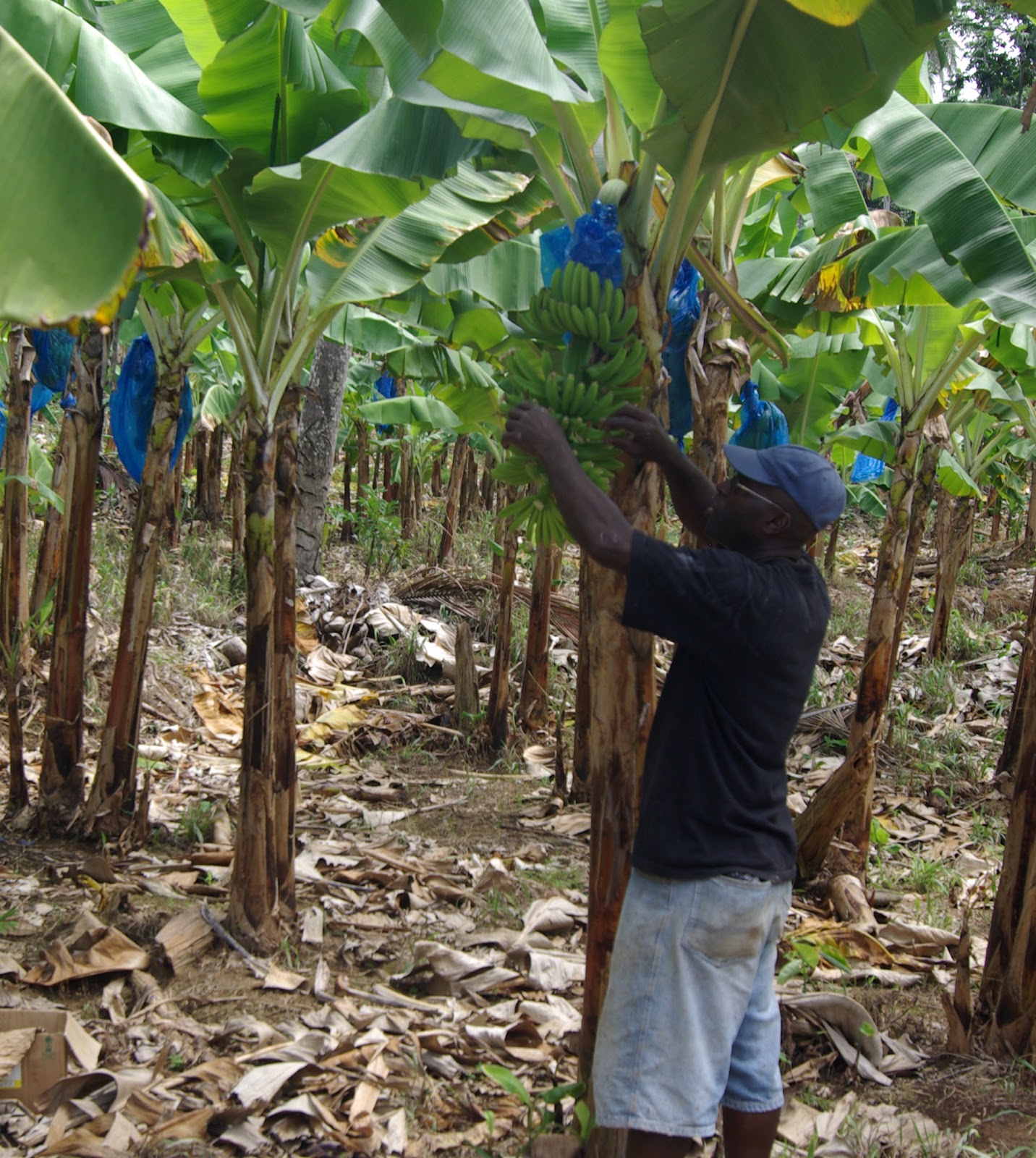 |
| A banana plant is deflowered! .The blue bags protect them from insects and reduces marking on our perfect yellow fruit. |
With the stupid supermarket prices wars, some of these plantations will not survive, as non-mechanised production is labour intensive and not competitive. Then more unemployment in Dominica.
Everyone is so friendly and welcoming on the island. It missed the development of massive slash and burn clearance for plantations, as it is so mountainous, and it missed the beach holiday boom by not having beautiful sandy beaches, and now with a young (37) and enlightened prime minister the country is going for the eco-tourism dollar. Since they have more virgin rain forest than anywhere else in the Caribbean they have a unique opportunity to exploit it in the right way. A network of tracks has been cleared, using some old slave tracks (used by slaves to hide in the mountains) and it is now possible, since December 2011, to walk the entire length of the island through varied terrain, rain forest, to plantation, to dry new forest in the north west where the English established a fort to protect our interests from the French in the 18th century.


Here in early March we were still experiencing the 'Christmas winds', or enhanced trade winds of 20 knots. Someone forget to tell the wind that Santa has gone! As we anchored in the bay we were screeched at by an American boat who wanted to have the entire bay to themselves it seemed. Albert stood by in his little boat while we moved anchor yet again to get away from the 'screecher'. Albert came on board for a beer, and discussed river trip options, and gave us lots of information about the island and things to do.
Early next morning someone came on the VHF radio – 'Catamaran adrift! Catamaran adrift!' I looked out the window and there was indeed a catamaran off it's mooring, sailing across the wind of it's own accord, no-one on board, heading straight for the middle of Matador. I hastily jumped up to the cockpit to start the engine and push us forward out of it's way, but luckily the wind swung us round and the cat passed just behind us, on it's way to the beach, where it grounded. Seemed someone had not secured the ropes to the mooring properly. The boat boys were out in force by this time hauling it off the beach with no harm done, and towing it back to the mooring to re-secure it. The owner was blissfully unaware on a river trip.
At the same time another yacht was motoring around, still with a mooring buoy attached to the bow – no doubt the mooring line had snapped underwater. We are often encouraged to use mooring buoys to generate income for someone, and protect the seagrass on the bottom, but we've seen far too many casualties of mooring failures to trust them. We always use our own anchor and chain, and we know when it is set for a secure nights sleep – just a shame about all the others that don't! We always choose a sandy spot to anchor so we don't damage any coral.
 |
 |
(River trip $50EC per person).
 |
| River crab playing peek-a-boo |

 |
| Albert enjoys a nap while we look for wildlife up the river path |

A second day we joined a trip organised through our friend's boat-boy, Alexis, with Stanley as driver and guide. In a very clean and tidy minibus we toured the north half of the island on a 9 hour trip ($100EC pp). It was an excellent and really informative trip, and we learned to recognise the many sources of food that Dominica has in abundance – bay trees, cinnamon, coffee, cocoa, papaya, grapefruits, bananas, plantain, dasheen, yam, lemongrass. Information overload.
 |
| Cocoa |
 |
| Cashew |
We passed through a reserve where 3700 Carib indians live. They originally came from the Orinoco river in dugout canoes, and settled throughout the islands about 100 years before Colombus and his kind came and wiped out the local 'resistance'. The Caribs in turn were warlike people who had already displaced (and eaten) the original Arawak population of the Caribbean. Very few Caribs survive, and here they have their own reserve, own schools, and love a life close to nature. They are very skilled at basket weaving and carving, so there is lots of local authentic tourist tat for sale. One of only a few places where the souvenirs are not 'made in China'.
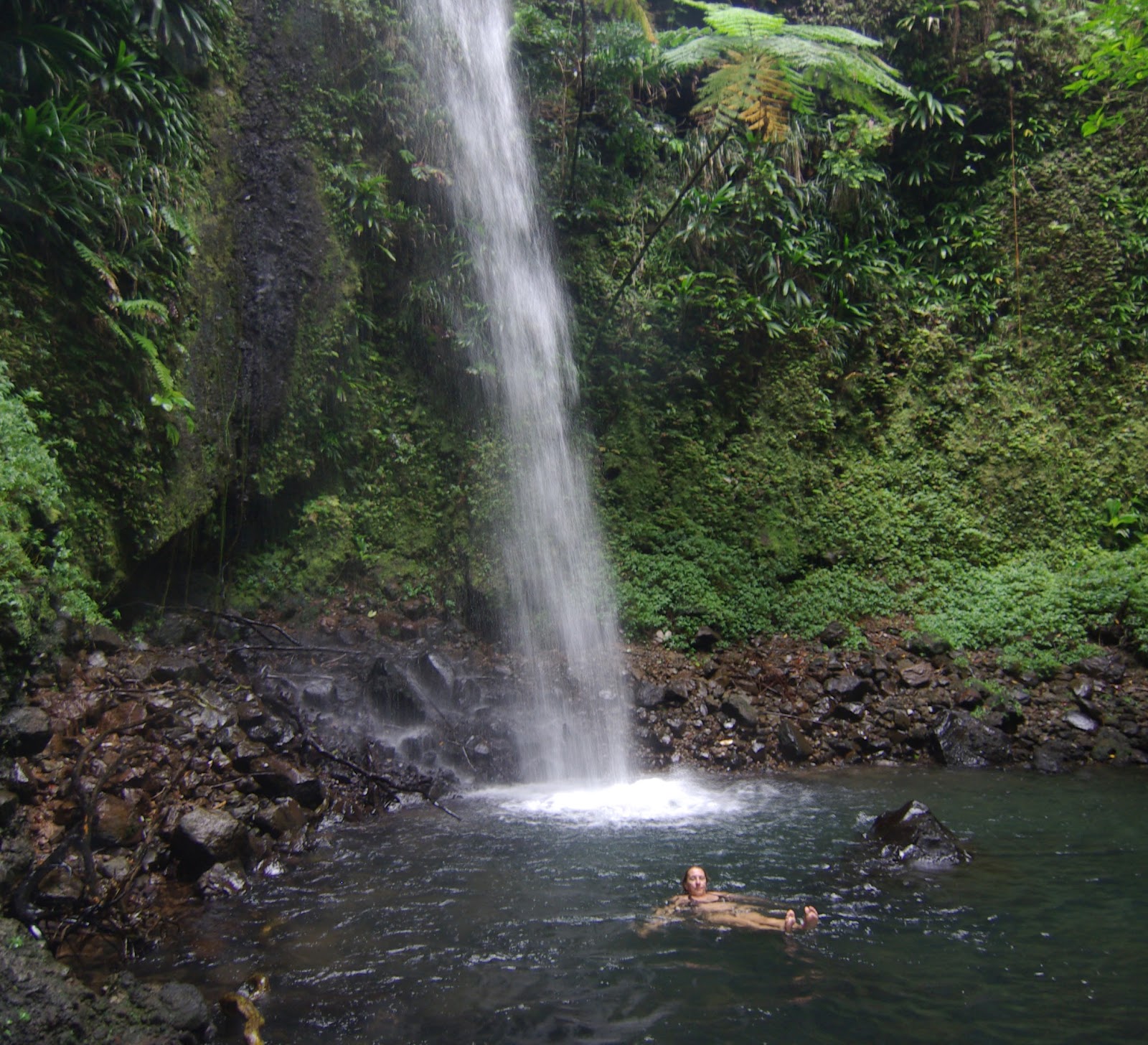
A short walk, and rope assisted climb over a short, steep ridge found us at the base of Spanny falls, and a quick dip was in order in the refreshing cool water.
A short walk, and rope assisted climb over a short, steep ridge found us at the base of Spanny falls, and a quick dip was in order in the refreshing cool water.

 |
Mike, Pete, Courtney, Claire at Chaudiere pool |
During our 2 week stay in Dominica we did 6 hikes, 3 BBQs, 2 music nights (with Pete and Courtney from Norna) watched 2 weekends of 6 nations rugby, and had a very sociable time indeed.
Pete and Courtney introduced us to their friends, a family of mum dad and 3 small kids, who live in a tree-house, with woven walls and a big fire to cook on downstairs. Dean really is close to nature, they eat off banana leaves, drink from bowls made of kalabash shells, and use plenty of leaves and plants in their diet. Amazing and gentle people, they made us very welcome on their beachside terrace.
Pete and Courtney introduced us to their friends, a family of mum dad and 3 small kids, who live in a tree-house, with woven walls and a big fire to cook on downstairs. Dean really is close to nature, they eat off banana leaves, drink from bowls made of kalabash shells, and use plenty of leaves and plants in their diet. Amazing and gentle people, they made us very welcome on their beachside terrace.
Details of the hikes are at the end, which might be of some use to other cruisers, who like us, can't afford to take a guide every-time they go for a walk. There are no guide books for the hiking, and most of the info on the internet is concerned with the southern end of the island around Roseau where the cruise ships dock, so we found out what we could from the internet about the Waitikubuli track and took a few chances on local buses. It makes life so much easier, being in an English speaking country, and the chances of getting lost or stuck at the end of the bus route and timetable are much diminished.
Our confidence to walk in the rainforest unaccompanied was greatly enhanced by the knowledge that Dominica has no poisonous nasty things. It has 2 types of benign constrictor snakes, they run way when they see you. No nasty machineel trees (elsewhere in the Caribbean, everything about these trees is poisonous, even the rain if you shelter under them). It doesn't even have prickys thorns. No malaria, no dengue, no yellow fever. It just has peace, beauty and a few very shy parrots.
Our confidence to walk in the rainforest unaccompanied was greatly enhanced by the knowledge that Dominica has no poisonous nasty things. It has 2 types of benign constrictor snakes, they run way when they see you. No nasty machineel trees (elsewhere in the Caribbean, everything about these trees is poisonous, even the rain if you shelter under them). It doesn't even have prickys thorns. No malaria, no dengue, no yellow fever. It just has peace, beauty and a few very shy parrots.
 |
| Hummingbird photo coutersy of Mike It was great to have a guide a couple of times to point out the wildlife, but discovering a blossom tree full of hummingbirds by accident is so much better for the spontaneity.  As we were out walking back from a swim in the lovely Chaudiere pool, we were walking along the road through a coconut palm estate, and coconuts of all sorts lay all around – green young ones with 'water' and no meat, and the brown ones with sweeter water and thick flesh – it all depends on their age. We found a couple on the ground, but the reality is that you have to remove the thick outer husk to get to the shell inside before you can get a drink. This really requires a machete, and no self respecting Dominican would be without one, but a machete is not the sort of thing one takes on a day hike, so we tried bashing the coconut on various sharp and hard surfaces, determined to overcome this obstacle. No luck, the coconut was not going to open itself. Then a local bus screeched to a halt in front of us, and backed up. Out jumped the driver, with machete, and in two seconds flat he had opened the coconut, bus passengers gazing on in amusement, and handed it back for us to share a drink. Then off he sped in his bus again – now where else in the world would that happen to you, I ask? There are plenty of places where you would be nervous of coming across someone armed with a machete in the middle of nowhere , but in Dominica they mount attacks on the local flora, not the visitors.  Sharing the coconut to quench our thirst   Cruising and hiking information Anchored, no charge Weeks pass for National parks $12US – needed for Indian river, Syndicate area, Cabrits park Taxi with Albert to check in on a Sunday - $25EC pp, a long trip across the bay, including taking Stu to the customs man's house, waiting while he did the paperwork, stopping for fill our fuel cans at the petrol station and a visit to the ATM. Check in approx $60EC inc overtime Indian river trip $50ECpp x 4 Day trip with Stanley (through Alexis) $100EC pp x 8 people Cabrits National park – walking on east or west side, lots of snakes, cannons and nice views. Segment 14 of Waitikubuli trail, starts opposite the anchorage near the entrance to Cabrits park - nice walk along Douglas bay and north west coast. Segment 13 Bus from outside the 'Green Light' on main street does circuit to Pennville, Vielles Case & back to Portsmouth. We got off at Cold Soufriere (don't bother, it's pathetic) walked downhill on beautiful mountain pass, on the bus route, after 1mile turn left onto segment 13. Bus back from Capucin. 3.5 hours walk. Segment 11 Syndicate Trail - taxi to Syndicate visitor centre (80EC for 4) from bus station. Centre is 5 miles, uphill from main road! Segment 11 to Borne goes through plantation and virgin rain forest, with squawky parrots. 6 hours, with steep up and downs. Options to get out at wooden bridge (down to Ross) or at sharp right turn below gazebo ( down to Indian river). From Borne, take bus back to Portsmouth. Looks like its possible to do segment 10 from Syndicate visitor centre, and down hill to Colihaut, bus back to Portsmouth, but this is untried! Chaudiere Pool and Calibishie: Bus from Portsmouth to Bense, ask to get off at the path to the pools, it's marked from there, and there is no need for a guide, even if they tell you there is. 45 mins each way. Buy something from the nice rasta man who looks after the trail though. We walked back out and along the bus route to Calibishie, then took the bus back to Portsmouth. |
Sunday, March 4, 2012
Martinique, Carnival time
Martinique, Carnival, 22 Feb 2012


After spending one night at Pigeon Island, and partaking of the excellent food in Jambe de Bois again (we didn't check in to St Lucia) we carried on up to Martinique. It is a part of France and the EU, they speak French, little English, and have euros, Carrefour supermarkets and typical French attitude. I went ashore to check in, and was immediately struck by their inability to share a pavement with anyone else. No matter what action I took faced with an oncoming pedestrian – trying to guess which way they would move, or stopping for them to pass, I was just forced onto the road, and nearly run over. I think they have the same problem with space awareness when they are anchoring their boats and tying up alongside you.
We failed to check-in on Saturday when we arrived as it was already the start of Carnival and all officialdom was closed. It has a very relaxed attitude to check-in so we were not concerned and we just flew our French courtesy flag and carried on as normal.
We heard that two boats (Innamorata & Tactical Directions) we last saw in Barbados were here, so it was time to be sociable again, and we anchored with them at the capital city, Fort de France, also the birthplace of Josephine, of the Napoleon fame. When they left, Siga Siga and Mary Ann 2 arrived so the social life continued without interruption.

Carnival is usually and traditionally held on Mardi Gras (fat Tuesday), which we know as Shrove Tuesday or pancake day, and is 60 day before Good Friday. A time to use up all your fatty stores of butter, meat, and sugar before you give them up for lent. It has taken on a party atmosphere broken from it's Catholic roots, an opportunity for the community to celebrate in style.
Each day, Saturday to Wednesday, there was a parade from 4pm to 7pm, with drumming bands, marching bands, and lots of people dressed for a bad taste fancy-dress party.


Each day had a different theme; pyjamas, the parody of marriage, red and black devils, and black and white, as far as I understood from the French pamphlet. Everyone was in good humour, there was not a policeman in sight in the 5 days we were there, and although a fair bit of rum was being consumed in the cars and floats, there was not a sign of drunkenness in the whole affair. Lots of noise, lots of men dressed as women, and all over by 7pm, the city deserted within 30 minutes of the end – they didn't bother to clear up the litter everyday, but it was all smart again on Thursday morning, when the businesses reopened. We don't know what Carnival is like in the other islands, so we will be cautious in our design of next years outfits, just in case cross dressing is just a French thing. How embarrassing would it be to turn up in, say, Trinidad next year, Stu in his slinky undies and basque, and everyone else dressed as rainforest animals for instance. Local advice should be sought I think.

We took the time between parades to track down a problem with our electronic autohelm, that had suddenly developed Alzheimers, and was liable to wander off without warning in any direction it felt like. Fearing an expensive replacement part necessary, Stuart went ahead with removing floorboards and emptying the food lockers to get to the electronic compass. With the help of the advanced trouble shooting help on the manufacturers website, and a voltmeter, Stu tracked the problem down to a broken wire between compass and computer, and it was solved with the installation of a new wire, and lots of soldering. Rejoice, rejoice, the autohelm's senile dementia was reversed.
I took the opportunity to catalogue and repack the stores into the lockers and we dined on Fray Bentos pies in celebration.
Tactical Tony has a dive compressor on board for refilling dive bottles. What a useful chap to know. We headed up north to St Pierre for a couple of days, with Innamorata, who like us had not done any diving since they passed their PADI certificate some years back. Our equipment was as rusty as our technique, but I re-read the instruction book, we took our antihistamines (to prevent blocked snotty tubes interfering with clearing your ears as you go down) and donned the cumbersome gear, extracted from the bottom of the boat locker. .
The first dive, Stu and Tony managed to get down, but Steve & Carol couldn't unblock their ears, I was stung by tiny things in the water, and then after being swept away from the dinghy in the windy and choppy sea, my jacket decided not to keep any air inside it. This is a BAD thing, as you also have a weight belt to enable you to descend despite the buoyancy of your wetsuit, body fat and air in jacket. I swam furiously back to the dinghy and removed my weights (I could have just dropped them where I was, but it was very deep!) and decided that was enough excitement for one day. The boys filled the tanks again, we had a mediocre French meal ashore and started again the next day, this time on a much shallower site. The Mount Pelee volcano towers over the area, and it's last eruption in 1902 killed 30,000 people – only 2 survived in the city; a cobbler in his cellar and a prisoner in his cell. Who says crime doesn't pay? 12 ships were lost in the eruption of the volcano and now make interesting dive sites around the coast. We had a delightful dive, and my now repaired BCD jacket functioned perfectly and I've reminded Stu that I don't have a life insurance policy for him to cash in, so he'd do better keeping me alive and cooking! The superstructure of the ships above the sand, makes a base for coral to grow, and then the fish and eels come to live among the shelter of the coral. The wreck can be seen from the surface in 7-9m, so is accessible to snorkellers, but it was great to be able to float effortlessly down among the fishies, turtles and eels. What we at first thought was a type of sea weed, turned out to be hundreds of little worms with their heads and bodies about 30cm out of their holes, swaying in the current. As we approached, they all disappeared rapidly into the safety of the holes, proving themselves definitely not seaweed.
Tony filled out bottles again, and we are fit to repeat the exercise at a later date, when the conditions suit. There are heaps and heaps of dive sites around, so we won't be lacking choice.
We learned that it was possible to check in at St Pierre for a limited time in the mornings of Carnival, this to be done at the tourist office. Elsewhere you have to visit immigration, customs, health and port control with several copies of boat papers, passports and cash. In Martinique, you put your details into the computer yourself, print out an A4 sheet, which the tourist office lady stamps officially, and no-one asks for papers, proof of who you are or where or when you came from, or cash. You have to admire the French for that, at least, and the bread and cheese, and Carrefour supermarkets and wine bag-in-box.......
We are now anchored back in St Pierre, with Siga Siga, and it has been raining constantly for 4 hours. At least it was a chance to get the blog up to date. The trouble with being 'mariners' is that you've looked at the forecast, and you know that it's going to continue for some time, and how heavy it it going to be. No respite. Just got to get on with the interior jobs and ignore the rain pitter patter on the roof, .
Hopefully it will clear tomorrow, and we will walk to the volcano, and if it's too far we will stop at the rum distillery for sampling. It's all in the cause of science, you understand. And one day, the internet will work somewhere, and I will post this blog.


Martinique is the most northerly island of the Windward Islands. Next stop, Dominica, the start of the Leeward Islands.


After spending one night at Pigeon Island, and partaking of the excellent food in Jambe de Bois again (we didn't check in to St Lucia) we carried on up to Martinique. It is a part of France and the EU, they speak French, little English, and have euros, Carrefour supermarkets and typical French attitude. I went ashore to check in, and was immediately struck by their inability to share a pavement with anyone else. No matter what action I took faced with an oncoming pedestrian – trying to guess which way they would move, or stopping for them to pass, I was just forced onto the road, and nearly run over. I think they have the same problem with space awareness when they are anchoring their boats and tying up alongside you.
We failed to check-in on Saturday when we arrived as it was already the start of Carnival and all officialdom was closed. It has a very relaxed attitude to check-in so we were not concerned and we just flew our French courtesy flag and carried on as normal.
We heard that two boats (Innamorata & Tactical Directions) we last saw in Barbados were here, so it was time to be sociable again, and we anchored with them at the capital city, Fort de France, also the birthplace of Josephine, of the Napoleon fame. When they left, Siga Siga and Mary Ann 2 arrived so the social life continued without interruption.

Carnival is usually and traditionally held on Mardi Gras (fat Tuesday), which we know as Shrove Tuesday or pancake day, and is 60 day before Good Friday. A time to use up all your fatty stores of butter, meat, and sugar before you give them up for lent. It has taken on a party atmosphere broken from it's Catholic roots, an opportunity for the community to celebrate in style.
Each day, Saturday to Wednesday, there was a parade from 4pm to 7pm, with drumming bands, marching bands, and lots of people dressed for a bad taste fancy-dress party.


Each day had a different theme; pyjamas, the parody of marriage, red and black devils, and black and white, as far as I understood from the French pamphlet. Everyone was in good humour, there was not a policeman in sight in the 5 days we were there, and although a fair bit of rum was being consumed in the cars and floats, there was not a sign of drunkenness in the whole affair. Lots of noise, lots of men dressed as women, and all over by 7pm, the city deserted within 30 minutes of the end – they didn't bother to clear up the litter everyday, but it was all smart again on Thursday morning, when the businesses reopened. We don't know what Carnival is like in the other islands, so we will be cautious in our design of next years outfits, just in case cross dressing is just a French thing. How embarrassing would it be to turn up in, say, Trinidad next year, Stu in his slinky undies and basque, and everyone else dressed as rainforest animals for instance. Local advice should be sought I think.

We took the time between parades to track down a problem with our electronic autohelm, that had suddenly developed Alzheimers, and was liable to wander off without warning in any direction it felt like. Fearing an expensive replacement part necessary, Stuart went ahead with removing floorboards and emptying the food lockers to get to the electronic compass. With the help of the advanced trouble shooting help on the manufacturers website, and a voltmeter, Stu tracked the problem down to a broken wire between compass and computer, and it was solved with the installation of a new wire, and lots of soldering. Rejoice, rejoice, the autohelm's senile dementia was reversed.
I took the opportunity to catalogue and repack the stores into the lockers and we dined on Fray Bentos pies in celebration.
Tactical Tony has a dive compressor on board for refilling dive bottles. What a useful chap to know. We headed up north to St Pierre for a couple of days, with Innamorata, who like us had not done any diving since they passed their PADI certificate some years back. Our equipment was as rusty as our technique, but I re-read the instruction book, we took our antihistamines (to prevent blocked snotty tubes interfering with clearing your ears as you go down) and donned the cumbersome gear, extracted from the bottom of the boat locker. .
The first dive, Stu and Tony managed to get down, but Steve & Carol couldn't unblock their ears, I was stung by tiny things in the water, and then after being swept away from the dinghy in the windy and choppy sea, my jacket decided not to keep any air inside it. This is a BAD thing, as you also have a weight belt to enable you to descend despite the buoyancy of your wetsuit, body fat and air in jacket. I swam furiously back to the dinghy and removed my weights (I could have just dropped them where I was, but it was very deep!) and decided that was enough excitement for one day. The boys filled the tanks again, we had a mediocre French meal ashore and started again the next day, this time on a much shallower site. The Mount Pelee volcano towers over the area, and it's last eruption in 1902 killed 30,000 people – only 2 survived in the city; a cobbler in his cellar and a prisoner in his cell. Who says crime doesn't pay? 12 ships were lost in the eruption of the volcano and now make interesting dive sites around the coast. We had a delightful dive, and my now repaired BCD jacket functioned perfectly and I've reminded Stu that I don't have a life insurance policy for him to cash in, so he'd do better keeping me alive and cooking! The superstructure of the ships above the sand, makes a base for coral to grow, and then the fish and eels come to live among the shelter of the coral. The wreck can be seen from the surface in 7-9m, so is accessible to snorkellers, but it was great to be able to float effortlessly down among the fishies, turtles and eels. What we at first thought was a type of sea weed, turned out to be hundreds of little worms with their heads and bodies about 30cm out of their holes, swaying in the current. As we approached, they all disappeared rapidly into the safety of the holes, proving themselves definitely not seaweed.
Tony filled out bottles again, and we are fit to repeat the exercise at a later date, when the conditions suit. There are heaps and heaps of dive sites around, so we won't be lacking choice.
We learned that it was possible to check in at St Pierre for a limited time in the mornings of Carnival, this to be done at the tourist office. Elsewhere you have to visit immigration, customs, health and port control with several copies of boat papers, passports and cash. In Martinique, you put your details into the computer yourself, print out an A4 sheet, which the tourist office lady stamps officially, and no-one asks for papers, proof of who you are or where or when you came from, or cash. You have to admire the French for that, at least, and the bread and cheese, and Carrefour supermarkets and wine bag-in-box.......
We are now anchored back in St Pierre, with Siga Siga, and it has been raining constantly for 4 hours. At least it was a chance to get the blog up to date. The trouble with being 'mariners' is that you've looked at the forecast, and you know that it's going to continue for some time, and how heavy it it going to be. No respite. Just got to get on with the interior jobs and ignore the rain pitter patter on the roof, .
Hopefully it will clear tomorrow, and we will walk to the volcano, and if it's too far we will stop at the rum distillery for sampling. It's all in the cause of science, you understand. And one day, the internet will work somewhere, and I will post this blog.


Martinique is the most northerly island of the Windward Islands. Next stop, Dominica, the start of the Leeward Islands.


Subscribe to:
Posts (Atom)